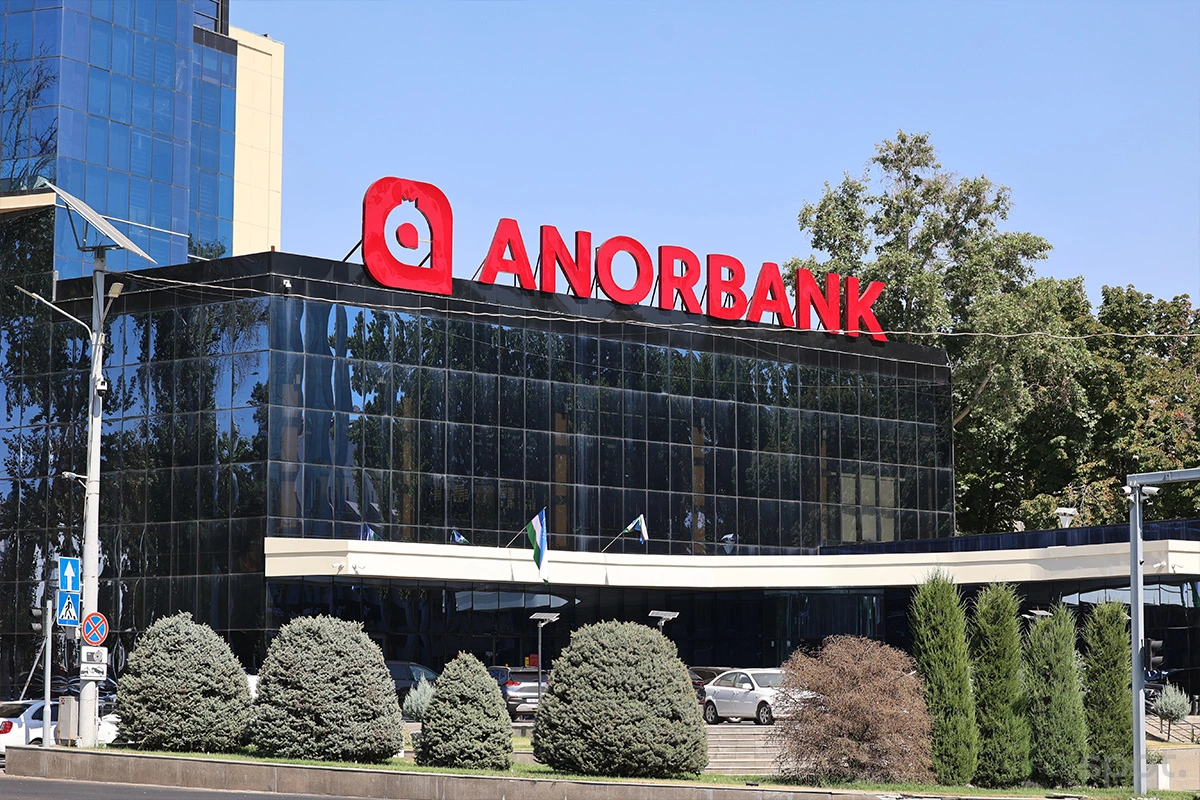
In recent days, various reports concerning private Anorbank and one of its founders, Kakhramonzhon Olimov, have appeared in foreign media. The situation has prompted comments from the bank itself and the Central Bank, which separately provided information on Anorbank’s financial condition.
At the same time, Spot cannot independently verify the information published by the Russian online outlet The Insider. No official comments on the matter had been received at the time of publication. None of the businessmen mentioned in the report had publicly commented on the situation.
What The Insider reports
On September 18, The Insider reported that Kakhramonzhon Olimov, who was reportedly kidnapped and tortured in France in the summer of 2025, is now allegedly accused of kidnapping. According to the outlet, Olimov has been remanded in absentia in Uzbekistan and placed on an international wanted list. Spot did not find a corresponding notice on the Interpol website. The Insider cited an alleged “source close to Olimov’s circle” for this information.
The outlet itself notes that there is no official information about the case. According to its anonymous source, Olimov may have staged his own kidnapping in France in order to portray his “former employer and opponent in an economic dispute, Batyr Rakhimov” as the organizer of the crime. Rakhimov is the founder of Kapitalbank, former president of the Pakhtakor football club and chairman of the Tennis Federation of Uzbekistan. As Gazeta.uz reported, Olimov served as chairman of Kapitalbank’s board in 2017, when he held a 36.06% stake in the bank.
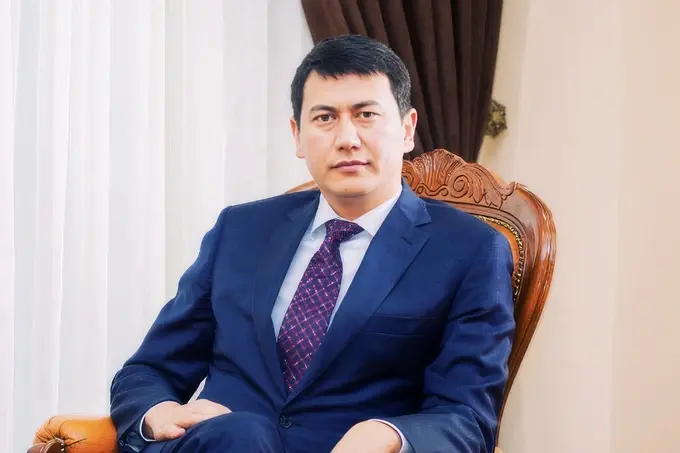
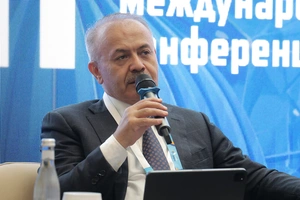
Kakhramonzhon Olimov. Photo: Kakhramon Olimov / LinkedIn
The Insider writes that Olimov is now allegedly accused of defaming Rakhimov by accusing him of organizing the kidnapping and then, with the assistance of Uzbek security forces, arranging Rakhimov’s kidnapping himself. According to the outlet’s source, this may have been done to force Rakhimov, under threat of criminal prosecution, to abandon his financial claims against Olimov.
Rakhimov had previously accused Olimov of misappropriating business assets belonging to him and sought more than $200 million in compensation, The Insider reports.
Anorbank’s position
Amid the reports concerning one of Anorbank’s shareholders, the bank stated that the matter concerns personal issues unrelated to the bank, its capital, management or operations.
“Mixing these issues together is incorrect and unacceptable”, the bank said.
Anorbank also said it had received no official confirmations or inquiries regarding the matter. According to the bank, the information being circulated by various sources is not supported by official data and has not been confirmed by the relevant authorities.
The bank stressed that it continues to operate normally: all banking operations, customer services and obligations to clients and partners are being carried out as usual.
“We urge our clients, partners and the public to treat publications from unverified and anonymous sources critically and to rely exclusively on reliable information confirmed by official sources. For reliable information, we encourage everyone to use only the bank’s official channels”, Anorbank said.
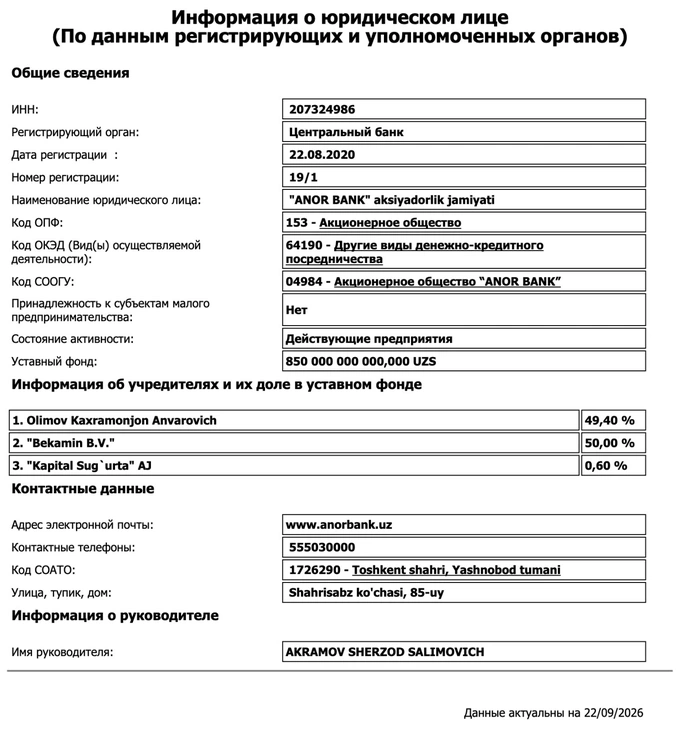
According to the Unified State Register of Enterprises and Organizations, Kakhramonzhon Olimov is a member of Anorbank’s supervisory board and owns 49.4% of the bank’s shares. Another 50% is owned by Dutch company Bekamin B.V., while 0.6% belongs to insurance company Kapital Sug’urta.
Kakhramonzhon Olimov was born in 1977. In 1999, he graduated from the Andijan Institute of Engineering and Economics with a degree in Finance and Credit. In 2012, he graduated from the Higher School of Business under the Academy of State and Social Construction under the President of Uzbekistan, earning a Master of Business Administration degree.
Central Bank’s comment
The Central Bank also stated that the situation involving an individual shareholder does not directly affect Anorbank’s current operations or financial stability.
The regulator said the bank continues to provide deposit, lending, payment and other services without interruption, meets its obligations to customers and ensures business continuity.
As of September 1, 2026, Anorbank’s assets amounted to 21.4 trillion soums, while its liabilities stood at 19.8 trillion soums.
Highly liquid assets accounted for 16.9% of total assets, compared with a minimum requirement of 10%. The liquidity coverage ratio (LCR) stood at 116%, while the net stable funding ratio (NSFR) was 128%, against a minimum requirement of 100%.
The bank’s regulatory capital adequacy ratio was 13%, compared with a minimum requirement of 12%.
The Central Bank noted that these indicators demonstrate Anorbank’s compliance with current prudential requirements for liquidity and capital adequacy.
The kidnapping case in France
The story surrounding Olimov received widespread attention in the summer of 2025, when, according to French media reports, he said he had been kidnapped in central Paris and then taken first to an unknown location and later to a villa near Nice. According to his account, he was beaten and tortured there and was demanded to pay $10 million. After agreeing to sign an acknowledgment of debt for $5 million and handing over $200,000, he was released and subsequently went to the police.
In November 2025, The Insider and French outlet L’Express conducted an investigation into the case. The outlets said they had found “numerous contradictions” in Olimov’s account and “signs of a possible staging” of the kidnapping.
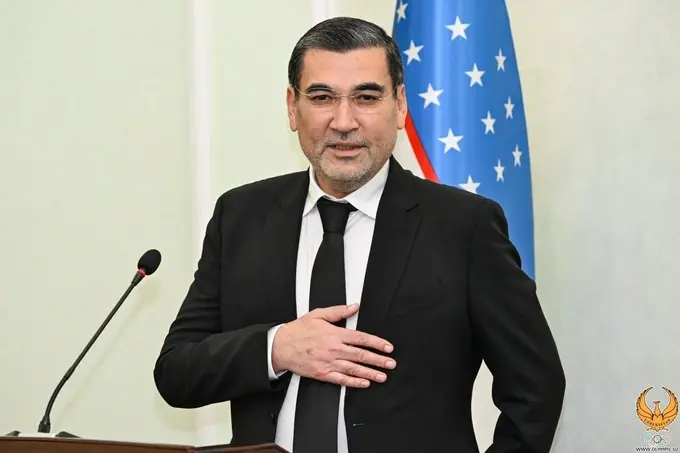
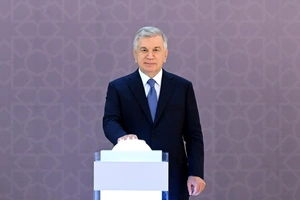
Batyr Rakhimov. Photo: Ministry of Sports
The outlet also links the case to a long-running financial dispute between Olimov and Rakhimov. According to the investigation, after Rakhimov left Uzbekistan for Turkey in 2016, a significant part of his business came under Olimov’s control and was subsequently transferred to him as a result of a deal that Rakhimov later considered highly unfavorable. After returning to Uzbekistan, he sought to have the deal reconsidered and demanded more than $200 million in compensation from Olimov.
The English version of this material was generated with the assistance of AI translation tools and may differ slightly from the original text.