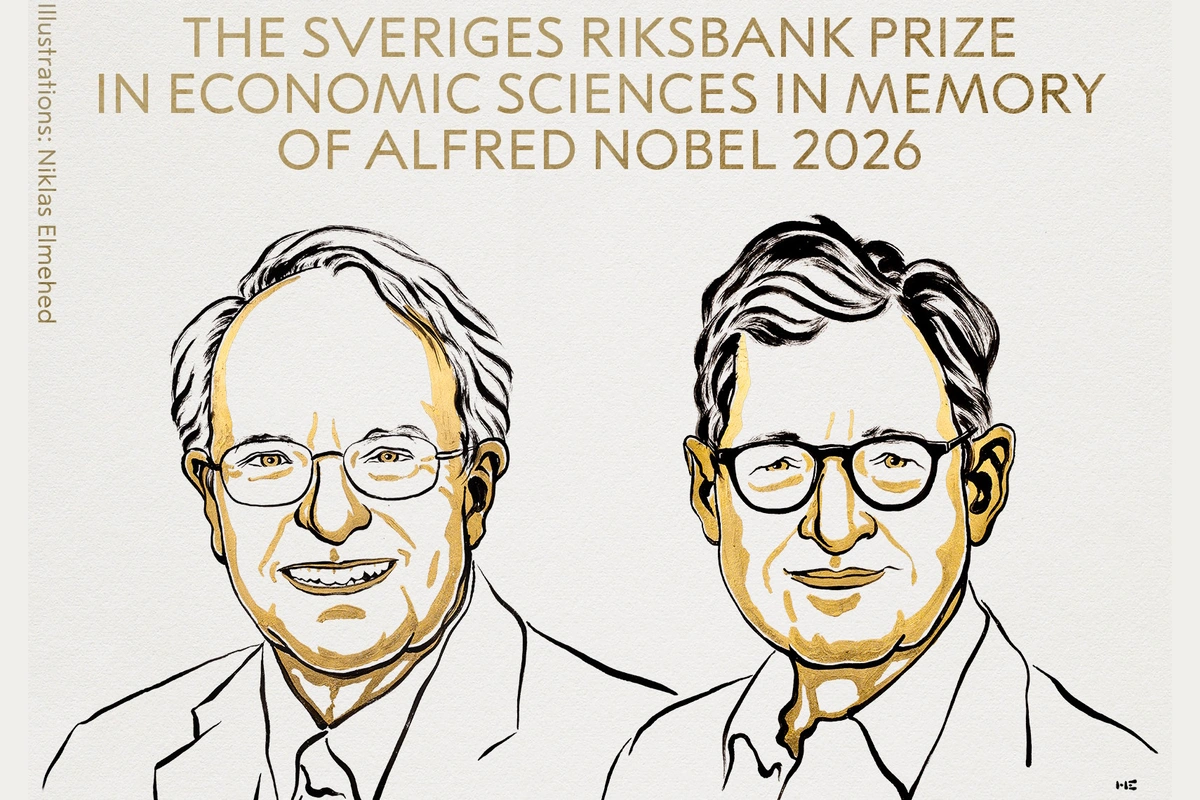
The Nobel Committee has announced that the Sveriges Riksbank Prize in Economic Sciences in Memory of Alfred Nobel has been awarded to American economists Robert Hall and Michael Woodford “for the microeconomic foundations of macroeconomic stabilization”.
Both economists will receive 50% of the prize money, amounting to 5.5 million Swedish kronor ($578,000) each. According to the committee, they developed macroeconomic models that “significantly improved” the ability to stabilize economies effectively during periods of crisis.
“Timely fiscal and monetary policy measures based on these models can mitigate economic fluctuations and downturns,” the Nobel Committee said in a press release.
Stabilization policy, which aims to smooth economic fluctuations, is based on the ideas of British economist John Maynard Keynes. It involves cutting interest rates and increasing budget deficits to stimulate the economy during recessions, as well as raising rates and implementing fiscal austerity during periods of growth.
During the oil crises of the 1970s, policies based on Keynesian models failed to reduce unemployment or accelerate GDP growth, while contributing to higher inflation in Western countries. This led to growing views that the harm caused by stabilization policies outweighed their benefits and that the approach had become outdated.
Hall and Woodford demonstrated how economic models could be reconstructed to improve stabilization policy. Rather than relying on correlations between macroeconomic indicators such as inflation, output and consumption, they based their approach on microeconomic indicators.
The new approach makes it possible to determine “how the combined actions of individual households and firms affect the economy”. According to the economists' findings, both households making saving decisions and businesses setting prices for goods and services base their choices on expectations about the future.
Governments and central banks can influence these expectations and steer the economy in the desired direction by informing the public about their economic policy plans. The Nobel Committee noted that the new models have proved “extremely useful” in mitigating the effects of crises in recent decades.
“The work of this year’s laureates has provided a robust theoretical foundation for the models used by central banks and governments around the world. Thanks to their work, we can better manage economic shocks, such as energy crises or sudden changes in household consumption,” said John Hassler, chair of the Committee for the Prize in Economic Sciences.
The English version of this material was generated with the assistance of AI translation tools and may differ slightly from the original text.