
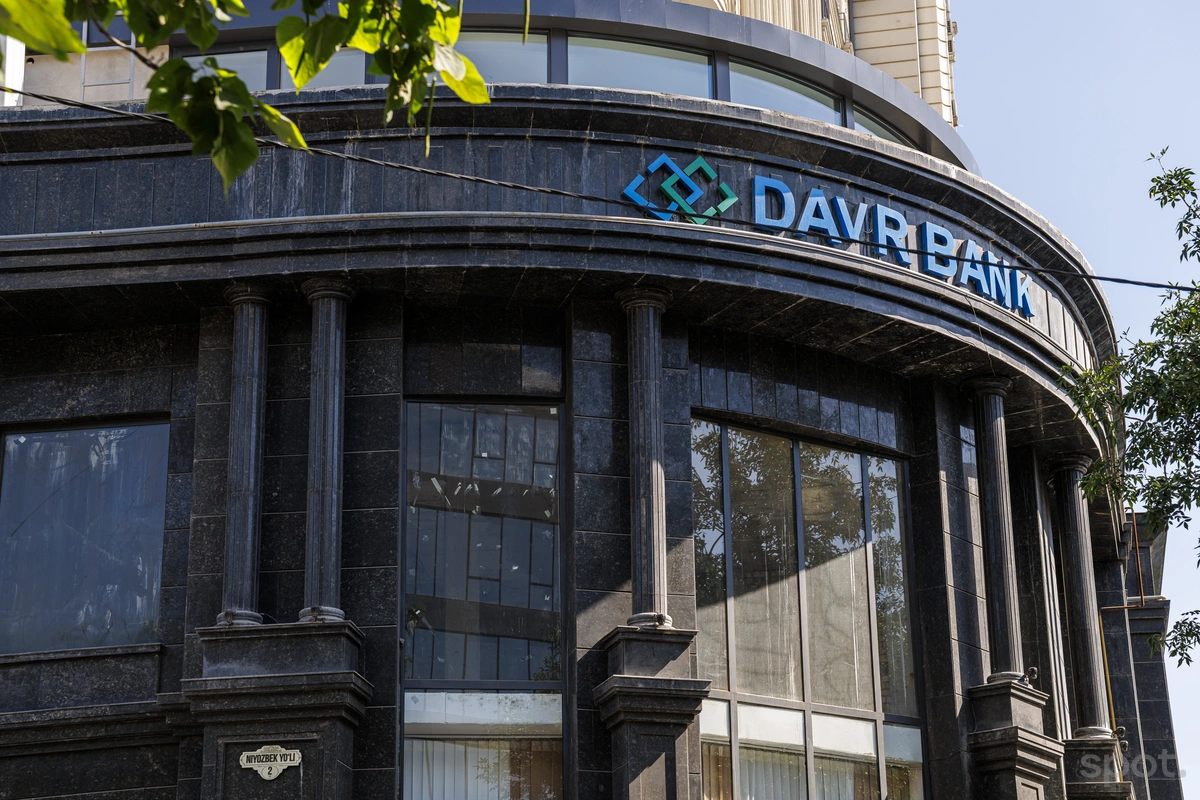
The International Bank of Azerbaijan (ABB) acquired a 51% stake in Davr Bank for 1.646 trillion soums, or about $140 million. The deal was completed on September 10 on the Toshkent Stock Exchange. In May, it was reported that ABB planned to acquire a controlling stake for around $100 million.
As ABB Chairman of the Management Board Abbas Ibrahimov said, once all official procedures are completed, the bank will operate under a new brand — ABB Davr.
For the International Bank of Azerbaijan, the deal marks its first major investment outside Azerbaijan. For Davr Bank, it means a change in its controlling shareholder and the arrival of a strategic investor with resources to support further development.
At the same time, the final deal value turned out to be higher than the initial estimate. This raises questions about how the bank was valued and what exactly ABB acquired along with the controlling stake. In addition to the bank’s financial performance, factors such as its market position, customer base, banking license and growth potential may have influenced the deal value.
Spot spoke with experts to find out why ABB sought control of Davr Bank, how they assess the deal, and what the arrival of a foreign investor could change in Uzbekistan’s banking market.
How justified is the valuation?
The final deal value was approximately $40 million higher than the amount discussed at the beginning of negotiations. In May, it was reported that ABB planned to acquire a 51% stake in Davr Bank for around $100 million. In September, the controlling stake was sold for 1.646 trillion soums, or about $140 million.
Experts interviewed by Spot note that it is not entirely accurate to compare the two figures directly. The bank’s financial performance may have changed over several months, while the deal involved the acquisition of a controlling stake. Therefore, the price of a 51% stake does not necessarily have to be calculated as a simple proportion of the bank’s total value.
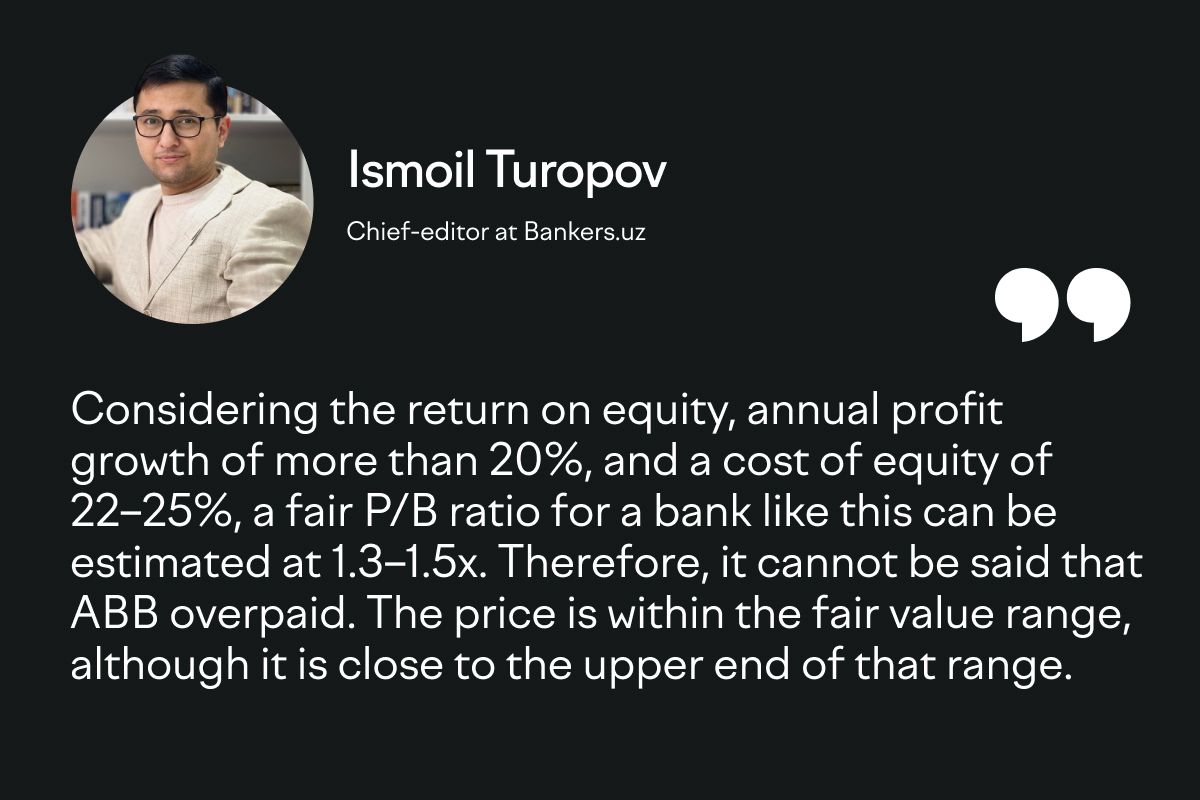
Bankers.uz head Ismoil Turopov suggests assessing the deal using two key indicators: P/B, the ratio of a bank’s market value to its equity, and P/E, the ratio of its value to earnings. At the final deal price, Davr Bank is valued at approximately 3.23 trillion soums, or $273.6 million. This is about 1.35 times the bank’s equity, which stood at 2.4 trillion soums as of the first half of 2026. Davr Bank’s profit reached 631.5 billion soums in 2025, meaning the bank’s current valuation is approximately five times its annual profit. Its return on equity stands at 28−30%.
According to the expert, the combination of high return on equity and profit growth suggests that the valuation can be considered close to fair.
At the same time, book value alone does not reflect the value of a controlling stake. By acquiring 51% of the shares, the buyer gains the ability to participate in key decisions, determine the bank’s strategy and influence the composition of its governing bodies.
Shakhram Sadullaev, head of the legal department at German company RÖDL, notes that the final price may have reflected not only Davr Bank’s financial performance but also the results of due diligence conducted before the deal.
“The value of a 51% stake cannot be assessed solely in proportion to the value of the entire bank. A controlling stake gives the buyer the ability to determine the bank’s strategy and influence the formation of its governing bodies, which is why a control premium is typically reflected in its value. In addition, the final price may depend on the results of financial and legal due diligence, the quality of assets and liabilities, the commercial terms of the deal, as well as the buyer’s plans for further capitalisation and development of the bank,” Sadullaev said.
Turopov estimates the control premium itself at around $35−40 million. Excluding this premium, the value of the 51% stake could have been around $105−110 million. In this case, the difference between that figure and the actual $140 million price could be viewed as payment not only for a share of the bank’s capital and profits, but also for the ability to manage the bank, its customer base, licence, brand and existing infrastructure.
For deals in emerging markets, the expert estimates that a control premium can range from 20% to 40%. In the case of Davr Bank, the premium is roughly within this range.
Another factor in Turopov’s valuation is the low liquidity of shares on the Toshkent Stock Exchange. According to his calculation, after excluding the control premium and applying a 15−25% discount for low liquidity, the value of the 51% stake in Davr Bank could have been around $85−100 million.
Why ABB sought a controlling stake
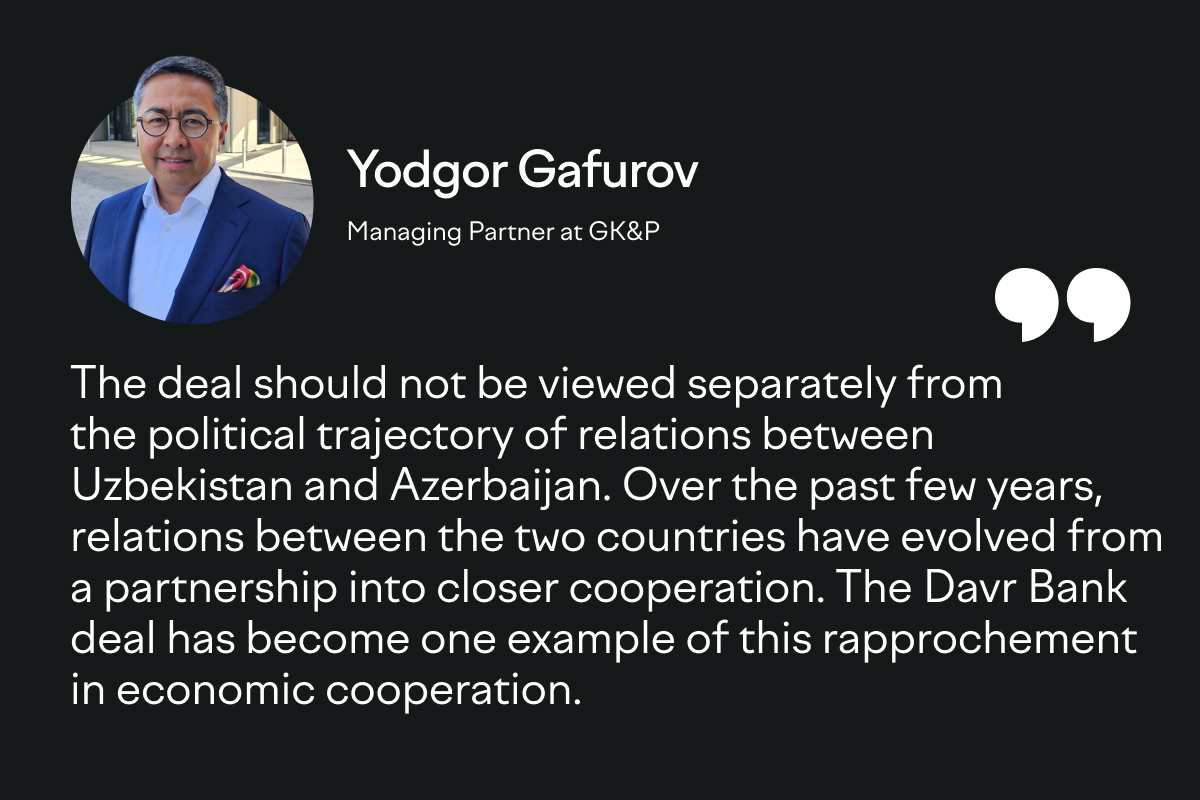
For ABB, the acquisition of Davr Bank goes beyond a conventional investment in a financial asset. Yodgor Gafurov, managing partner at GK&P, links the deal to the broader rapprochement between Uzbekistan and Azerbaijan.
Over the past several years, relations between the two countries have evolved from a partnership into a formal alliance. In 2023, the Supreme Interstate Council was established. In 2024, the two sides signed a Treaty on Allied Relations, while in 2025 they approved a roadmap for cooperation through 2029. In August 2026, the presidents of the two countries signed a Treaty on Eternal Friendship.
Against this backdrop, economic projects have become one of the instruments for developing bilateral relations. Gafurov views the Davr Bank deal as an example of a shift from political agreements to investment presence.
According to his assessment, Uzbekistan is of interest to ABB primarily as a large and rapidly growing market. Acquiring an existing bank allows it to avoid building a business from scratch and immediately gain operational infrastructure, a customer base and a presence in the country. Davr Bank has more than 2 million customers, 43 service points and assets of over $1 billion. The bank also has a significant focus on lending to small and medium-sized businesses. According to S&P, Davr Bank’s return on equity stood at 35.6% in 2025.
“For ABB, this is an opportunity to expand beyond its domestic market and immediately gain an operating banking business. This is not a project that needs to be launched from scratch. Davr already has customers, infrastructure and the scale needed to operate in the market from day one. For ABB, this is the first step in its geographical expansion,” Gafurov said.
The expert also sees additional potential in the existing presence of Azerbaijani businesses in Uzbekistan. Companies with Azerbaijani capital are involved in projects in energy, precious metals mining, construction, tourism, industry, agriculture and investment. These include SOCAR, AzerGold, NEQSOL, PASHA, Azerbaijan-Uzbek Investment Company and others.
For ABB, this represents a potential corporate customer base. The bank could serve Azerbaijani companies already operating in Uzbekistan, finance trade operations and support investment projects. Another area is settlements and trade finance related to transport routes through the Caspian region and the Middle Corridor.
The acquisition of a controlling stake also requires separate regulatory approval. Shakhram Sadullaev noted that under Article 22 of the Law “On Banks and Banking Activities”, the direct or indirect acquisition of 50% or more of a bank’s shares requires prior approval from the Central Bank.
“The regulator assesses the buyer’s ownership structure, financial condition and business reputation, ultimate beneficial owners, and the potential impact of the deal on the bank’s stability”, Sadullaev explained.
In the case of ABB, Gafurov believes the buyer’s profile itself was an important factor. At the same time, the long-term presence of Azerbaijani capital in Uzbekistan is supported by intergovernmental agreements. Gafurov therefore views the buyer not as a financial investor seeking to exit the asset within several years, but as a strategic partner with a long-term interest in the market.
Another factor that influenced the deal was a change in the valuation of Davr Bank itself. Ismoil Turopov and Yodgor Gafurov note that S&P Global Ratings upgraded the bank’s rating from B to B+ with a stable outlook. The agency linked the upgrade, among other factors, to Davr Bank’s status as a strategic subsidiary of ABB and the potential support from its new owner.
Gafurov also points to the structure of Uzbekistan’s banking market. As of mid-2026, nine state-owned banks controlled more than 60% of the sector’s assets. Against this backdrop, the emergence of a major foreign owner in a private bank could have implications not only for Davr Bank itself but also for strengthening the private banking segment.
What will change in the banking market
ABB’s entry adds another major foreign player to Uzbekistan’s banking system. The market already includes TBC, OTP, Ziraat, KDB and other foreign banks and financial groups.
However, the impact of a foreign owner is not necessarily going to come in the form of a sharp reduction in interest rates. The cost of loans still depends on the Central Bank’s monetary policy, inflation and funding costs.
“The mere arrival of a foreign owner does not mean that lending rates will fall sharply. The cost of borrowing depends, among other factors, on the Central Bank’s monetary policy, inflation and funding costs. However, cheaper and longer-term funding from a strategic investor could gradually increase competition in the market”, Turopov said.
In Davr Bank’s case, another factor is its improved credit rating. According to the head of Bankers, this could make it easier for the bank to access international financing and create conditions for further growth in its loan portfolio. S&P forecasts Davr Bank’s loan portfolio to grow by 20−25% in 2026 and by 30−35% in 2027−2028. According to Turopov’s assessment, the bank’s net interest margin could range between 10% and 10.3%.
At the market level, competition could gradually shift from the cost of money to the quality of banking products themselves. Foreign players bring new technologies and risk-management approaches, while customers increasingly value faster decision-making, convenient digital channels and access to specialised products.
Turopov expects customer experience to become one of the main areas of competition, particularly digital services and products for small and medium-sized businesses.
“The most visible competition will be for customer experience: digital channels, the speed of credit decisions, and products for small and medium-sized businesses. If a customer can get a loan faster or resolve an issue through an app, that becomes a competitive advantage”, the expert said.
For smaller banks, stronger competition could encourage them to seek clearer specialisation. According to Turopov, players that lag behind technologically while lacking a distinct niche will have to change their business models or consider merging with other market participants.
At the same time, the impact on customers will not necessarily be reflected in lower service costs:
“The arrival of a strategic foreign investor could have a positive impact on competition, corporate governance, risk management and the quality of customer service. However, lower banking service costs are not an automatic result of such a deal — they depend on the level of competition, funding costs and regulatory requirements”, Sadullaev said.
Strategic investor or IPO
In August, trading in Davr Bank shares resumed on the Toshkent Stock Exchange after a 5.5-year hiatus. The shares trade under the ticker DRBK.
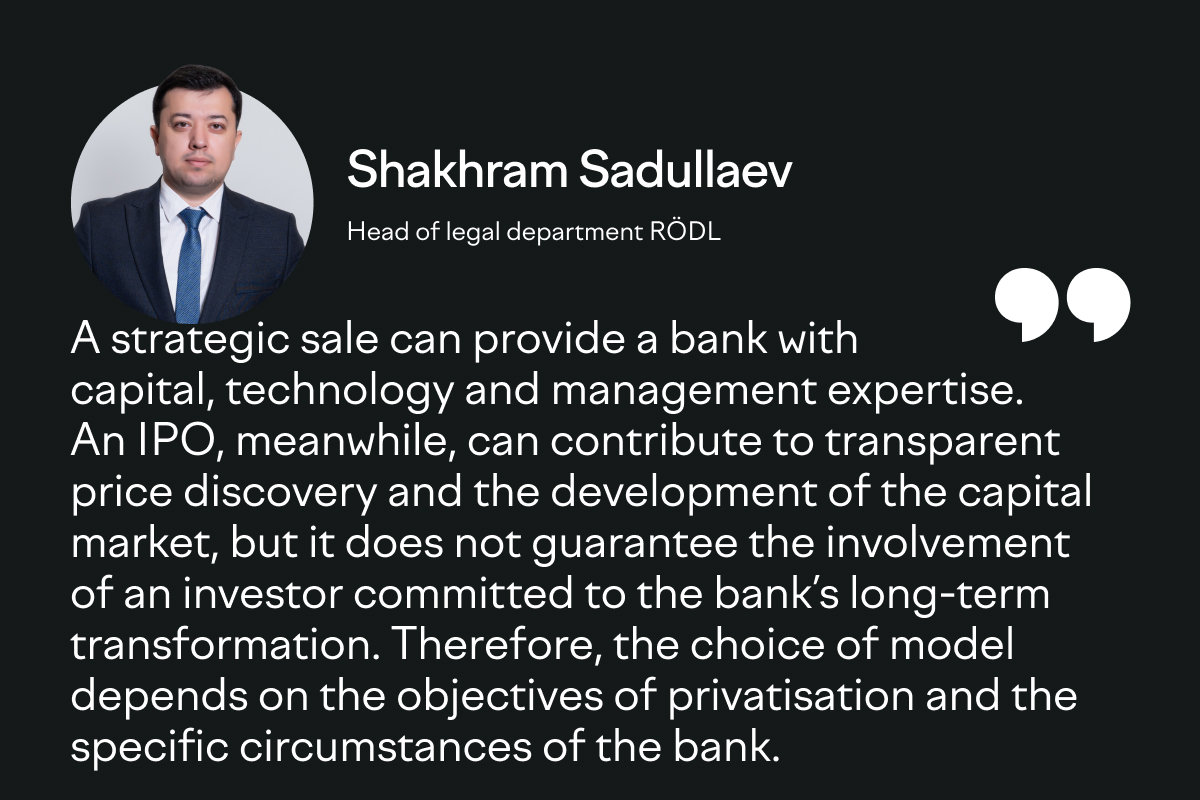
According to experts, a strategic sale and an IPO serve different purposes. In the former case, the bank gains a specific owner that can participate in management, provide capital and transfer technologies. A public offering, by contrast, allows the bank to raise funds through the capital market, broaden its shareholder base and establish a market valuation for the company.
Sadullaev notes that each model has its own advantages and limitations.
Ismoil Turopov also highlights the differences between the two models from the owner’s perspective. A sale to a strategic investor can secure a higher price due to a control premium and allows the bank to gain access to technology, management expertise and financing more quickly. At the same time, concentrated ownership creates dependence on the strategy of a single major shareholder, while the integration of the businesses may involve additional risks.
An IPO, by contrast, helps develop the stock market, broaden the investor base and increase corporate transparency. However, in a shallow and relatively illiquid market, a public offering may require a discount, while the state or existing owner could receive less than it would from a sale to a strategic investor. In addition, an IPO does not by itself bring new management or technologies to the bank.
Therefore, the two models do not necessarily have to be mutually exclusive. One possible scenario is for a strategic investor to first acquire control, followed by the public offering of part of the remaining shares. Turopov considers such an option possible for Davr Bank.
“For Davr Bank, a hybrid model could be an interesting option: first selling a controlling stake to a strategic investor, followed by the listing of the remaining stake on the market. This would make it possible to combine the advantages of a strategic owner and the public market”, the expert said.
In this case, the future value of the shares would depend on the bank’s performance following ABB’s entry. The resumption of trading provides the necessary market platform for this.
“The resumption of trading after 5.5 years is significant in itself. It brings Davr Bank back to the public market. In the future, it could theoretically also sell another stake, for example 23%, taking into account the bank’s performance after ABB’s entry”, Turopov said.
The English version of this material was generated with the assistance of AI translation tools and may differ slightly from the original text.