
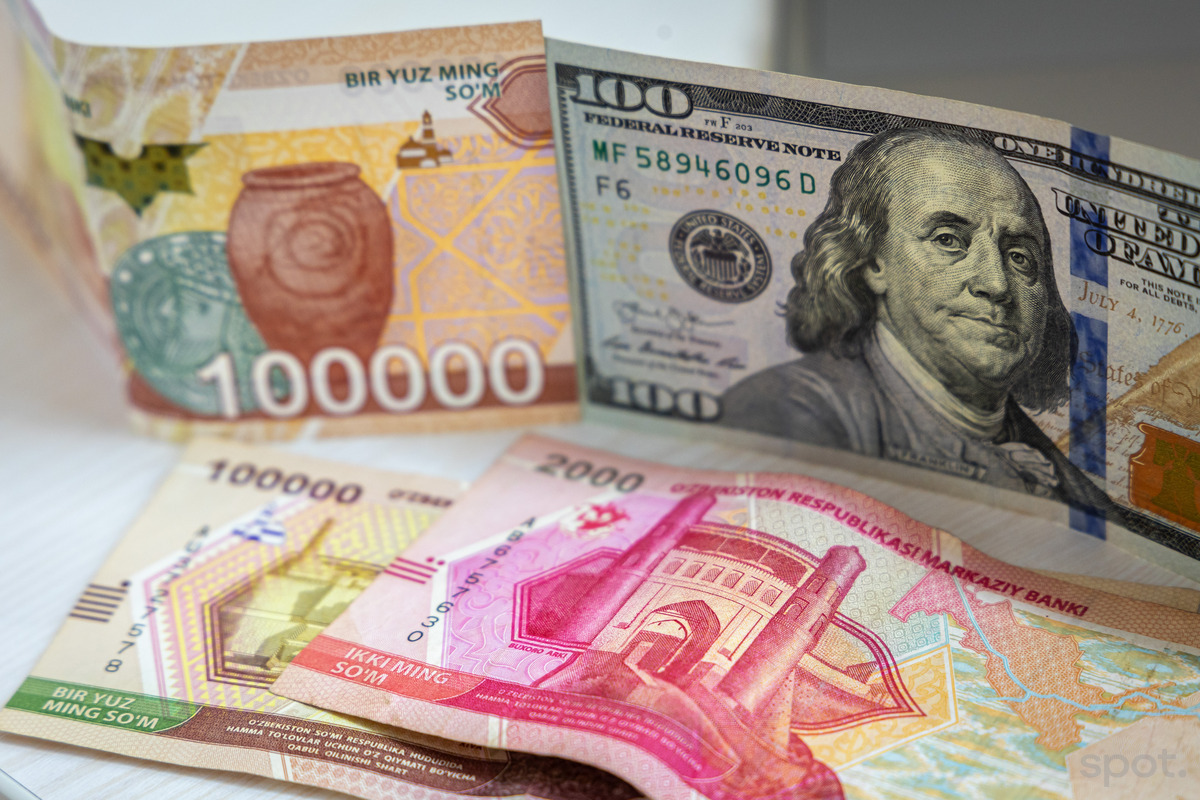
The dollar exchange rate on the currency exchange reached its highest level since late July on Thursday, October 15, according to Central Bank data.
At the end of trading, the US dollar gained 48.49 soums to reach 12,011.65 soums. This was its highest level since July 31.
The dollar has risen for eight consecutive business days since October 6. Its biggest daily increase was recorded on October 10, when the exchange rate gained more than 51 soums and reached 11,897 soums for the first time since mid-August.
Before this, the US currency had been on a prolonged downward trend following a sharp rise in February. Since early August, the dollar had remained below 12,000 soums and hit a new low five times since the August 10, 2023 devaluation. The most recent three-year low was recorded on September 11, at 11,765 soums.
Mirkomil Kholboev, author of the Mirkonomika Telegram channel, has explained the reasons behind the soum’s depreciation against the US dollar. According to him, the soum lost 2% of its value over the past nine trading sessions. The dollar has returned to its highest level since July 31, wiping out all the soum’s gains against the US currency since the beginning of the year.
Kholboev noted that most global currencies have weakened against the dollar in October. Of 39 selected currencies, 26 have depreciated, while eight have strengthened.
The dollar’s appreciation is attributed to the US Federal Reserve raising interest rates in September and growing expectations of another rate hike at its October meeting. Accelerating inflation in the United States has further increased the likelihood of a rate hike.
According to the economist, although the soum is among the currencies that have weakened against the dollar, it is also one of the most depreciated. This suggests that factors beyond the dollar’s global strength are affecting the soum’s exchange rate.
Kholboev identified several possible reasons:
One-off debt payments. A one-time demand for foreign currency to cover government or private-sector debt payments at the end of the third quarter may have temporarily increased demand for foreign currency.
The real exchange rate. The real exchange rate has strengthened since May. The Central Bank may be delaying interventions to prevent a decline in domestic producers' external competitiveness. Gold exports have fallen significantly this year compared with last year, potentially limiting the Central Bank’s ability to sterilise liquidity through foreign exchange operations.
Seasonal decline in remittances. A decrease in remittance inflows after the summer may have added to the pressure on the soum.
“The specific feature of a flexible exchange rate is that it responds to external or domestic shocks. If the soum is responding to certain developments, such as increased import demand or slower remittance inflows, then that is a good thing. Ultimately, the Central Bank does not target the nominal exchange rate,” he said.
Kholboev said he does not currently expect a sharp depreciation of the soum, as the factors that could trigger one are not evident for now. Exports and investment are continuing to grow actively, he noted.
Economist Otabek Bakirov also attributed movements in the soum’s exchange rate to its increased flexibility. He said the exchange rate is responding to domestic and external macroeconomic factors, including export and import trends, investment flows and credit channels.
The English version of this material was generated with the assistance of AI translation tools and may differ slightly from the original text.