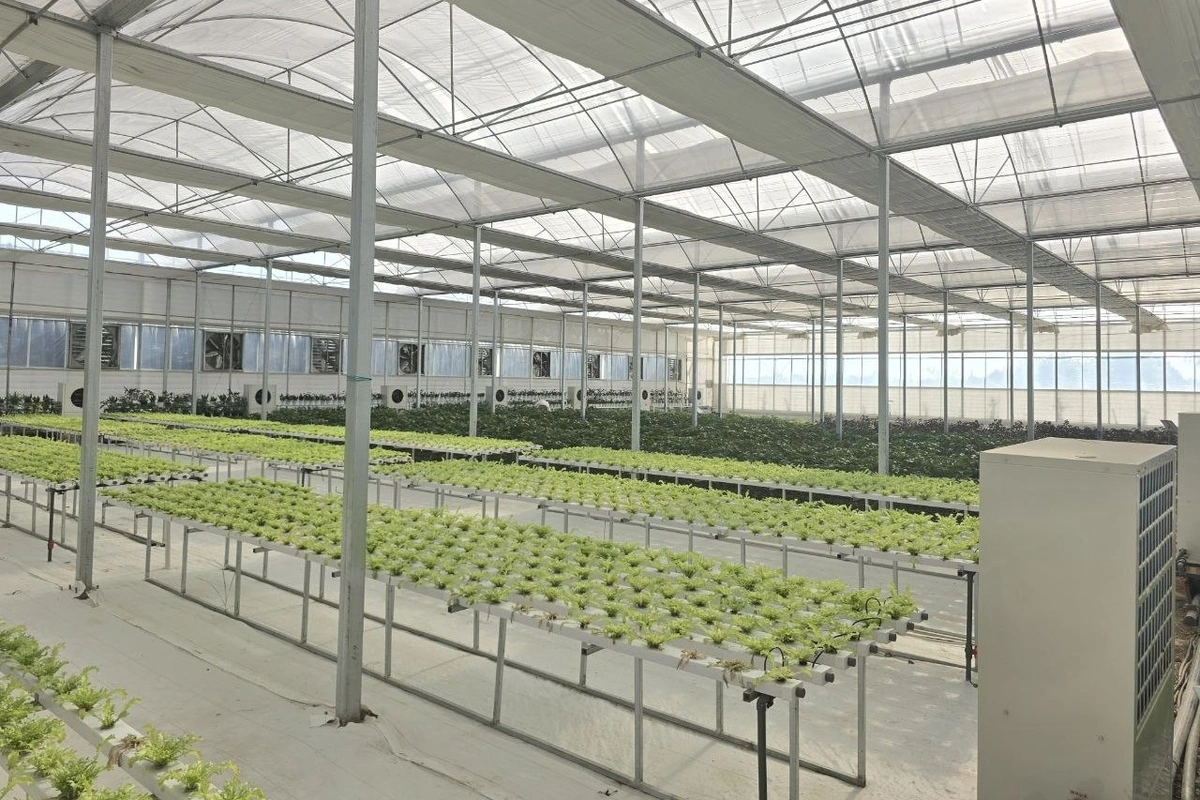
Greenhouse owners say they are not ready for new regulations set to take effect on December 1. They raised their concerns at a meeting with government officials at the Chamber of Commerce and Industry on November 16.
Under a government resolution dated October 22, 2026, greenhouses heated with coal and other solid fuels must switch to natural gas, electricity, geothermal, solar or thermal energy by December 1. They may continue using coal only if they install emissions filtration and continuous monitoring systems and obtain a positive environmental assessment.
No backup option
According to meeting participants, coal had served as a backup fuel when natural gas supplies were restricted. Business owners expect gas supply problems to continue this winter, but say the new rules leave them without an alternative for the current heating season.
“When there is not enough gas for households and our supply is cut off, we will have no alternative. We will not be able to use coal. The requirements for coal filters are extremely strict and impossible to meet. What are we supposed to do in such circumstances?” greenhouse owner Khojimurod Nurmonov asked.
Switching to liquefied gas would also be difficult in the near future, he said, citing storage requirements, the technical process and the need for substantial investment. He called on the authorities to give greenhouse businesses a specific timeframe for the transition.
“Europe did not make this transition in a day or a month. It took years. If we are told to prepare everything by a certain year, we will be ready by then. But if we are told to switch to this system tomorrow or in a month, it is physically impossible,” he said, responding to former Deputy Energy Minister Umid Madaminov.
Madaminov had previously suggested liquefied gas as one alternative, citing European countries as an example. He also said greenhouses would not be guaranteed uninterrupted natural gas supplies because of limited resources.
Monitoring systems costing hundreds of millions of soums
Greenhouse owners say the high cost of coal filters and emissions monitoring systems is another obstacle to meeting the new requirements.
A continuous emissions monitoring system (CEMS) alone costs 759 million soums, greenhouse owner Khurshid Akhmedov said, citing a commercial offer.
“Even if we wanted to buy the equipment right now, it is not available in Uzbekistan. Secondly, the technology is technically very complex. After being ordered from China, it takes 45 days to arrive. It then has to be adapted at the climate control facility before it can be installed,” he said.
According to Akhmedov, such systems are typically installed at boilers with a capacity of more than 100 MW, while boilers at greenhouses in Tashkent are approximately 100 times smaller. He proposed replacing the expensive CEMS with an Ecopost sensor costing 82 million soums. Eldor Khamroev, deputy head of the Department of Legal Expertise and Comprehensive Analysis of the Presidential Administration, instructed environmental officials to examine whether such a replacement would be possible.
Greenhouse owners asked to be allowed to complete the current growing season using filters without continuous monitoring systems. They said around 470 hectares of greenhouses in Tashkent Region could be affected, with crops expected to ripen between December 15 and January 1.
In addition to the cost of CEMS, greenhouse owners also raised concerns about equipment certification fees. Shamsiddin Nuriddinov, chairman of the Association of Florists, said the cost of the service had increased fourfold.
“It used to cost 9 million soums. Now, for the same boiler and filter, they are quoting us a different price — 37.8 million soums,” he said.
The English version of this material was generated with the assistance of AI translation tools and may differ slightly from the original text.