


international banker, chairman of the board of a bank and payment system, managing partner at Senteo Inc, and co-founder of the consulting firm Interise Group.
Uzbekistan’s financial market has changed significantly in recent years. Competition has intensified, and digital channels have become a familiar part of the customer journey.
For consumers, the boundaries between traditional banks, online banks, payment services and fintech ecosystems are becoming increasingly blurred.
Customers now compare financial institutions not by their legal status, but by convenience, speed, clarity and the end result. For them, a bank, payment service, mobile app, website, call centre and branch are not separate entities, but parts of a single experience of interacting with the financial market.
As a result, traditional customer service indicators no longer provide a complete picture. It is important to assess not only how politely customers are greeted at a branch or how modern a website looks. The key question is whether the entire system of interaction — including offices, websites, call centres, chats, mobile apps and staff — helps customers find a clear solution, choose a financial partner and sign up for a product.
To assess this, we at Interise Group used the international Global Customer Choice Index methodology. The index measures not abstract customer satisfaction, but a financial institution’s ability to become the customer’s primary choice: the bank, service or digital financial interface they are willing to return to, use to sign up for products and rely on to manage their everyday financial needs.
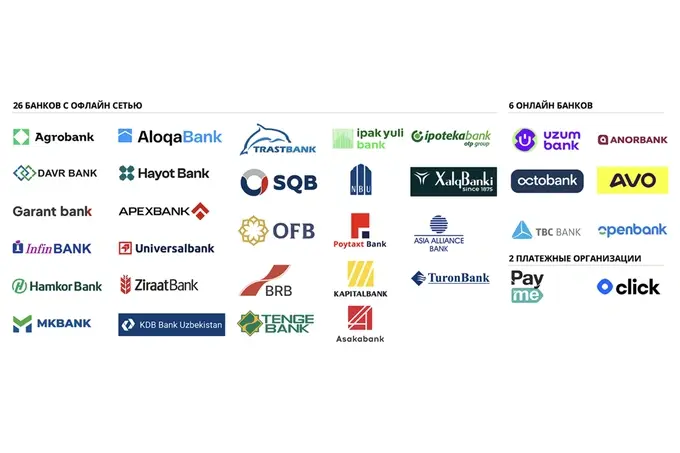
In 2026, the study in Uzbekistan covered 34 financial institutions, including banks with physical branch networks, online banks, payment services and digital financial players. Mystery shoppers conducted 336 visits, comprising 225 visits to 74 offices and 111 online visits. The study covered not only traditional banks but also digital players such as Click, Payme, Uzum Bank, TBC Bank, AnorBank, Octobank, Openbank, AVO Bank and other market participants.
Since 2022, Uzbekistan’s market has shown positive momentum. However, the research methodology has become more demanding over time, meaning that the absolute figures cannot be directly compared.
According to the Global Customer Choice Index 2026, Uzbekistan’s overall score was 2.92, with a volatility score of 1.77. The offline channel scored 2.91, while online channels scored 2.93.
What does this mean? We look at two indicators: customer experience and volatility. Volatility matters because customer experience directly affects repeat purchases. To keep customers coming back, financial institutions need to deliver consistent service.
Both indicators are measured on a five-point scale, where 3 represents standard market practice, 4 indicates the level of more advanced markets with a strong customer focus and intense competition, and 5 is the maximum score. Ratings are assigned by mystery shoppers who must be Uzbek citizens and assess branches, websites, chats, call centres and other customer touchpoints.
Volatility, meanwhile, measures not the average level of service, but how consistent it is. A score of zero means that all visits and channels received the same rating, indicating predictable service. The higher the volatility, the greater the variation. For example, with a volatility score of 1, one customer visit might receive a rating of 4 while another receives 3. Customers experience this as unpredictability — good service today, worse service tomorrow. Such inconsistency increases the risk of customers switching to another bank or service.
In 2026, Uzbekistan’s overall score was 2.92 out of a possible 5, while 3 is considered standard market practice. The offline channel scored 2.91 and online channels 2.93, meaning both remain slightly below the “normal” benchmark.
At first glance, offline and online channels appear to be performing at almost the same level. However, a more important conclusion emerges from the figures: the market has learned how to create a positive first impression, but does not always manage to guide customers through to the final outcome.
A similar pattern can be seen in more mature financial markets. Competition there has long shifted from the question of whether a bank has a branch, website and app to whether customers can complete their tasks without unnecessary steps or gaps between channels. In other words, the number of channels matters less than whether they function as a single system. Customer experience is therefore no longer just a separate service function within a bank, but part of how it grows and generates revenue.
Another notable gap is between retail banking and the SME segment, where banks specifically serve small and medium-sized enterprises. Retail banks scored 2.95, with volatility of 1.71, while SME-focused banks scored 2.84 and 1.91, respectively. This means the business segment lags behind in both average service ratings and consistency.
For businesses, this is particularly significant. Repeated paperwork, waiting times, complicated account-opening procedures and delays are not merely examples of poor service — they translate into direct operating costs. This is an important signal for a market where almost all banks are currently positioning SMEs as a strategic priority.
Offline service is in place, but difficult to scale
In the offline channel, the highest scores were recorded for the branch environment and customer service, both at 3.16 out of 5. Banks are investing in branch appearance, comfort, design, waiting areas and the culture of basic customer interaction. At many locations, mystery shoppers noted that employees were friendly, willing to help and able to handle simple requests quickly.
The main weakness is the technological capabilities of branches, which scored 2.55 out of 5. A modern branch can no longer be just a physical space with good interior design and polite staff — it must function as part of a unified digital process.
An offline branch should offer clear navigation, a reliable electronic queue system, minimal paperwork, a seamless transition to the mobile app and transparent data transfer between channels.
This highlights one of the market’s main challenges: service quality remains difficult to scale. Strong branches and employees are already in place, but a consistent customer experience is not delivered equally everywhere. This is particularly evident in large branch networks: the more service locations there are, the greater the risk of gaps between standards, processes and the actual behaviour of frontline staff.
Customer experience cannot be scaled through employee training alone. It requires standards, processes, management oversight, technological support and a consistent service model across every location in the network.
Otherwise, customers receive not a systematic service experience, but one that depends on a particular employee, branch and time of visit.
The main problem is converting interest into results
The “outcomes and channel integration” criterion deserves particular attention, as it shows whether the customer experience translates into choosing a bank or service and signing up for a product.
In the offline channel, employees often successfully address customers' basic needs, but they do not always use the visit as an opportunity to build the relationship further: guide customers towards digital channels, explain the next steps, offer a relevant product or help them install the app.
In only 37% of cases did employees tell customers about the availability of a mobile app. Many customers left without informational materials, assistance with installing the app or a clear next step in their customer journey.
In other words, a branch often functions as a service point, but not always as a place to strengthen customer relationships. Every visit should not only resolve an immediate issue but also deepen the customer’s connection with the bank’s ecosystem through its app, personalised offers, a clear path to signing up for a product and follow-up support.
Good service is about more than politeness. It is the ability to guide customers from interest to action, from consultation to signing up for a product, and from a one-off interaction to a long-term relationship.
A strong online presence, but a fragmented customer journey
The picture is similar across online channels. Financial institutions in Uzbekistan have learned to create high-quality digital storefronts. Company websites scored 3.38 out of 5 for first impressions and ease of use. However, the score for product information was just 3.18.
Users encounter modern design, mobile-friendly layouts, logically structured homepages and clear basic forms. Beyond that, the customer journey becomes more complicated. Important information about tariffs and terms may still be buried in documents or PDF files.
Completing a desired action can sometimes require too many steps. When customers switch between a website, app, chat and call centre, their interaction history is often lost. As a result, the digital journey looks modern at the outset but becomes less efficient as customers approach the point of signing up for a product.
The weakest area of the online experience is “outcomes and channel integration”, which scored 2.21, with volatility of 2.06. This is one of the study’s most important findings: customers may be able to access information but cannot always complete the journey to opening an account, signing up for a product or submitting an application independently and seamlessly.
This is critical for digital channels. They create value not when a website looks good, but when customers can achieve their goals without unnecessary barriers. Otherwise, a digital channel becomes a storefront that attracts attention but does not always convert interest into action.
Chat support still lags behind phone support
Another area for improvement is text-based support. The chat criterion scored 2.77 out of 5, below the rating for call centres. Customers who contacted support via chat reported several issues:
long response times;
rigid, button-based bots;
difficulty reaching a live operator quickly; and
interactions in which customers effectively go around in circles.
This is particularly important in a market where customers are increasingly accustomed to resolving issues through messaging apps and digital channels. If chat does not shorten the customer journey but instead makes it more complicated, it stops being a service tool and becomes a barrier to sales.
At the same time, the foundations for improvement are already in place.
Call centres demonstrate operator professionalism, politeness and the ability to provide accurate information once a connection is established. Websites have become more visually appealing. Branches are more comfortable. Employees can handle basic requests. The problem is not a lack of customer-focused thinking, but the fact that the customer journey remains fragmented.
Why this matters now
Uzbekistan is at an important stage in the development of its financial market. On the one hand, competition continues to grow among banks, payment organisations and digital players. On the other, regulatory and infrastructure initiatives related to fintech, digital financial infrastructure, investment and the development of market expertise are gaining momentum.
Customer experience is becoming part of the broader transformation of the financial sector, rather than a separate marketing or service issue. As digital infrastructure develops, customer expectations rise. People are no longer willing to put up with gaps between an attractive digital storefront, a complicated application process, an overloaded call centre menu and a branch that cannot see their previous interactions.
Uzbekistan is going through the same stage that more mature markets have already experienced or are currently navigating. Initially, financial institutions invest in individual channels: branches, websites, apps, call centres and chats. They then realise that these channels alone do not create a competitive advantage. That advantage emerges when all channels are connected into a single, integrated system.
What comes next
The main takeaway from the Global Customer Choice Index 2026 study is that Uzbekistan’s financial market has moved beyond the stage where improving individual customer touchpoints was enough. Going forward, the winners will not be those with a good branch, an attractive website and a polite call centre considered separately, but those that can integrate all these elements into a single, manageable customer journey.
Fintech players are already raising customer expectations. Traditional banks scored an average of 2.91 out of 5, while online banks and neobanks scored 3.14. This is one indication of why digital-native players are increasingly setting the benchmark for speed and ease of interaction.
Competition is therefore no longer limited to banks. It is taking place between different models of financial interaction: branches, apps, payment services, neobanks and ecosystems.
For traditional banks, this is not a threat in itself, but a signal that their operating models need to change. A bank of the future does not necessarily have to become a fintech company in the narrow sense, but it must learn to serve customers as quickly, clearly and seamlessly as the best digital services. For fintech companies to compete over the long term, convenience alone is not enough: they also need trust, reliability, a broad range of products and robust processes.
The next stage of the market will take shape at the intersection of these two approaches: the reliability of banking and the speed of fintech.
Customers no longer think in terms of “branches”, “websites”, “chats” or “call centres”. They want to get things done: open an account, receive advice, apply for a card, choose a loan, activate a service or understand the terms and conditions.
If a financial institution makes customers explain their situation again in every channel, search for information in different places and connect fragmented steps themselves, the customer experience loses its value.
What banks and fintech companies should do
For participants in Uzbekistan’s financial market, this creates several priorities.
First, reduce dependence on individual employees. A good customer experience should not be an exception, but a standard that can be consistently reproduced across the entire branch network and all channels.
Second, make branches more technologically advanced. Physical offices remain an important channel, particularly for complex products and interactions that require trust, but they must be integrated into the digital architecture rather than operate separately from it.
Third, develop genuine omnichannel services. Customers' interaction history should be preserved as they move between websites, apps, chats, call centres and branches.
Fourth, manage conversion, not just service quality. A visit, phone call or online enquiry should end not merely with an answer, but with a clear next step.
Fifth, redesign chat support and automation. Bots should not lead customers through endless menus; they should understand requests, shorten the customer journey and quickly connect users with a human agent when automation cannot resolve an issue.
Sixth, focus on product differentiation. The customer journey should not only be convenient but also explain why customers should choose a particular bank or service. If a product’s value is not clear, even a good interface may not persuade customers to switch their primary financial provider.
The market has already learned how to create a positive first impression. The key challenge now is to consistently guide customers towards a result. The next stage of competition in Uzbekistan will be determined by the quality of the phygital customer journey: from the first contact to signing up for a product, from interest to trust, from trust to choice, and from choice to use and business results.
Banks and fintech companies are already competing on the same playing field.
The English version of this material was generated with the assistance of AI translation tools and may differ slightly from the original text.